





5 Times Tradespeople Use the Wrong Tape
Posted by Mikey Callaghan on 20th Mar 2026
Every tradesperson has a roll of tape in their van. Probably several. And most of the time, whatever's closest to hand gets used for whatever job needs doing.
That works — until it doesn't. Until the tape fails, the customer calls back, and you're doing the job twice for free. Or worse, you're dealing with something that should never have failed in the first place.
Here are five tape mistakes we see all the time — and what you should be using instead.
"The difference between a call-back and a job done right is often just using the correct tape. It's a few pence difference that saves you hours."
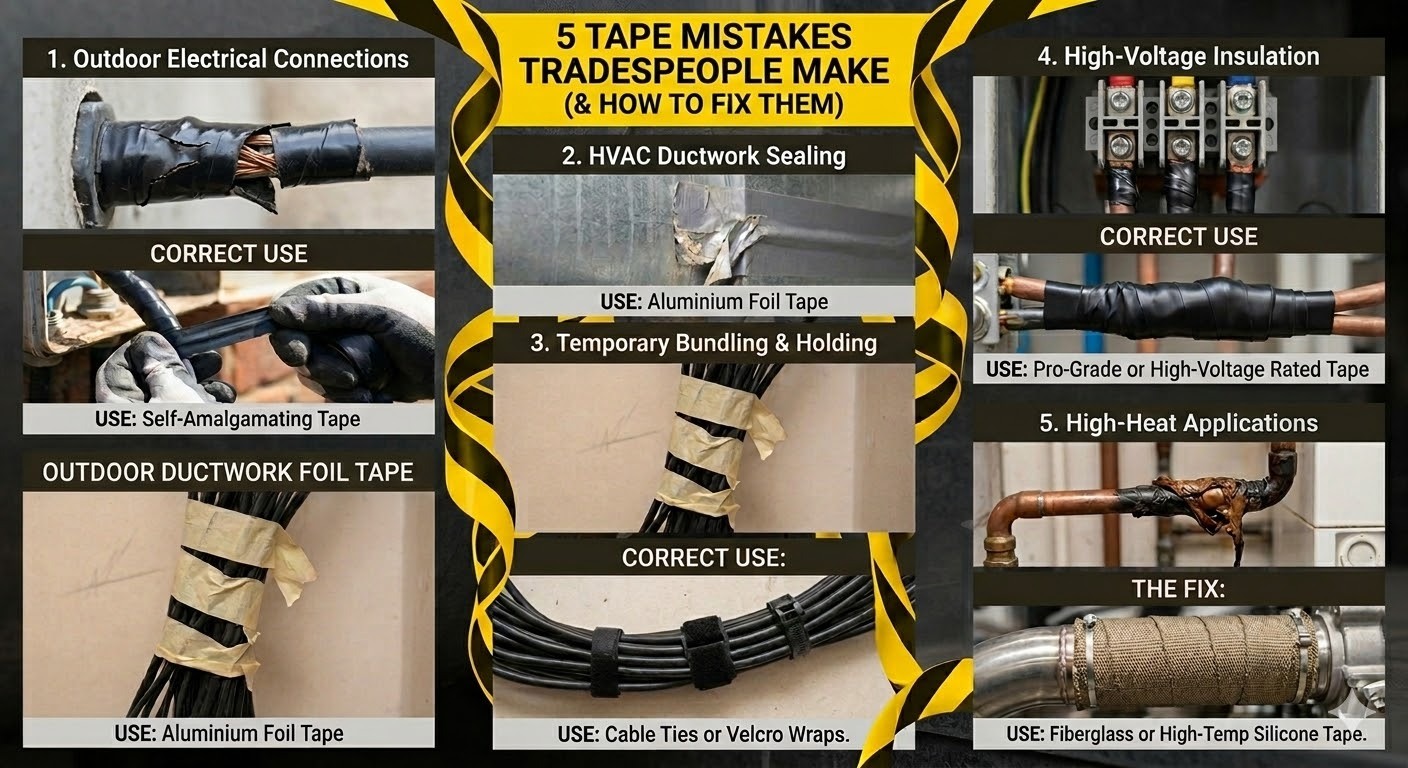
1. Using electrical tape to seal outdoor connections
Standard PVC electrical tape is fine for insulating connections indoors. But outside? It's not waterproof. It's not UV stable. And it starts breaking down the moment it gets direct sun and rain.
We've seen outdoor junction boxes opened up after 18 months where the tape has gone brittle, cracked, and left the connection completely exposed. Water gets in, corrosion starts, and suddenly you've got a fault that traces back to a join you taped up and forgot about.
What to use instead:
Self-amalgamating tape — it fuses to itself and creates a solid, waterproof seal that won't degrade in UV. For anything outdoors, underground, or exposed to moisture, this is the only tape that actually lasts.
2. Using duct tape on actual ducts
The irony isn't lost on anyone. Duct tape — the tape literally named after HVAC ductwork — is actually terrible for sealing ducts.
Standard duct tape uses a rubber-based adhesive that dries out and fails when exposed to temperature cycling. Hot air, cold air, hot air again — give it a year and that tape is hanging off. Building research has shown duct tape failing on HVAC systems within months, leaving gaps that kill your energy efficiency and let conditioned air leak into ceiling voids.
What to use instead:
Aluminium foil tape — it's rated for temperature extremes, won't dry out, and actually seals ductwork properly. Look for one with an acrylic adhesive rather than rubber. It costs more per roll, but you're not coming back to re-tape the same joint next winter.
3. Using masking tape as a permanent fix
Masking tape is for masking. It's designed to come off cleanly after painting. It is absolutely not designed to hold anything together long-term.
We've seen it used to bundle cables, secure access panels, even hold pipe lagging in place. Within six months it's yellowed, the adhesive has gone gummy or completely dried out, and whatever it was holding is now loose. On painted surfaces, you'll get adhesive residue that's a nightmare to remove.
The "it'll do for now" problem
Masking tape is cheap and it's always there. That's exactly why it gets used for jobs it was never meant for. If you're reaching for masking tape to fix something rather than mask something, stop and grab the right tape. "Temporary" fixes have a habit of becoming permanent.
What to use instead:
For bundling cables: cable ties or Velcro wraps. For securing panels or lagging: cloth/gaffer tape or proper fixings. For anything you actually want to stay put: literally anything except masking tape.
4. Using thin electrical tape on high-voltage work
Not all electrical tape is the same. That budget 10-pack from the trade counter? It's probably fine for low-voltage domestic work. But it's often thinner, less stretchy, and rated for lower voltages than you'd assume.
For anything above standard domestic voltages — three-phase, industrial panels, motor connections — you need tape that's specifically rated for the job. Thin tape applied over sharp edges or cable ends can get punctured or worn through, compromising the insulation exactly where you need it most.
| Tape Type | Typical Rating | Best For |
|---|---|---|
| Budget PVC tape | 600V max | Domestic, low-voltage |
| Professional grade PVC | Up to 1000V | General trade use |
| Self-amalgamating + overwrap | High voltage rated | Industrial, outdoor, HV |
5. Using standard tape near heat sources
Standard PVC tape, duct tape, even most cloth tapes — they're all rated to about 80°C at best. Near boilers, flues, heating pipes, or engine components, that's nowhere near enough.
The tape softens, the adhesive fails, and in some cases it can actually melt onto the surface it's stuck to. On exhaust systems or flue pipes, you're also creating a potential fire risk. It's not worth it.
What to use instead:
High-temperature aluminium tape for HVAC and moderate heat. Silicone self-fusing tape for anything up to 260°C. Fibreglass tape for exhaust wrapping and extreme heat applications. Check the temperature rating before you apply — if it doesn't say, assume it can't handle it.
The right tape costs pennies more — and saves you hours
None of these mistakes happen because tradespeople don't know better. They happen because the wrong tape is closer to hand, or cheaper to buy, or "good enough for now."
But good enough for now has a habit of becoming a callback in six months. And the cost of doing the job twice — plus the hit to your reputation — is always more than the difference between the cheap tape and the right tape.
Stock your van with the right tapes for the jobs you actually do. Self-amalgamating for outdoor electrics. Aluminium foil tape for HVAC. High-temp tape if you're near heat. It takes up the same space as the wrong tape — and it doesn't come back to bite you.