





Written By: Mikey Callaghan | Published: 30th September 2025
Confused about which fire safety signs your workplace needs? It doesn’t matter whether you manage a hotel, warehouse, office or construction site – getting your fire safety signs right is essential for keeping people safe and staying compliant.
Playing a vital role in emergencies, fire exit signs lead people to safety and show where fire extinguishers and fire equipment are stored. Although, as there are different colours, types and regulations to think about, it can easily get confusing.
If you’re reviewing fire safety in your workplace, you’ve come to the right place. Read on for an explanation of the different fire safety sign colours, their meanings and how to stay on the right side of the law.
Why fire signs matter
It’s no wonder that having fire safety signs in your workplace is a legal requirement. In emergencies, confusion and panic can spread as quickly as a fire, putting lives at risk. Having fire signs is essential in a situation when every second counts and responding calmly can make a huge difference to the outcome of an emergency.
Signs need to be clearly displayed in every workplace, showing fire exit routes, where extinguishers are kept and warning notices. This will make sure that your workers, visitors and customers are safe in all circumstances.
To help make compliance easier, GTSE offers a wide range of fire safety signs. They are designed to meet the all-important workplace regulations and create safer environments to help businesses stay prepared.
Types of fire safety signs
Here are the four main types of fire safety signs:
- Fire exit & escape route signs – Clear direction to safety, photoluminescent options for low light.
- Fire equipment signs – Identify location and type of fire extinguisher or hose reel.
- Warning signs – Highlight flammable substances, explosive risks, electrical fire hazards.
- Mandatory signs – Actions required to reduce fire risks (e.g., “Keep clear,” “Fire door keep shut”).
Fire safety sign colours and their meanings
Fire safety signs are colour-coded so it’s clear what they mean, even in a high-stress situation or one where there’s low visibility.
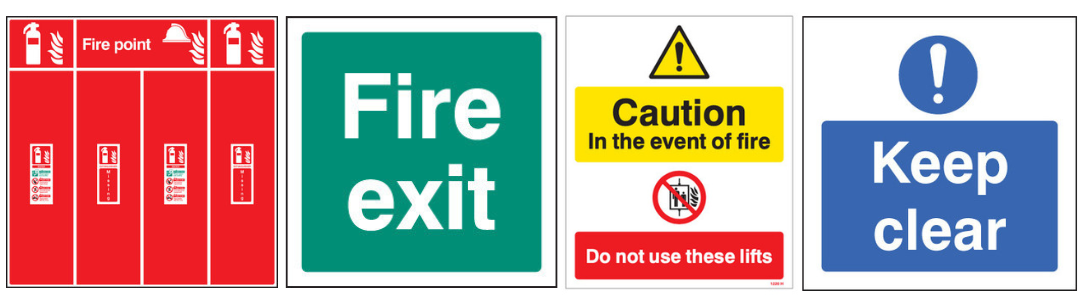
Safety and regulatory signs are built around the standard colours of red, green, yellow and blue to help workplaces comply and ensure people can quickly recognise what a sign is telling them.
Red
Red signs are the most familiar when it comes to fire safety. They are the colour of fire equipment signs, showing the location of fire extinguishers, fire alarms, “no smoking” and “do not enter” signs.
GTSE’s red fire-equipment signs are designed in the standard red format, usually with white pictograms. This design makes sure that important signs stand out clearly.
Green
Green signs link to people’s feelings of safety. They are used for escape routes, assembly point signs, first aid and safe areas.
Most people are familiar with the green exit signs. The ‘running man’ pictogram and arrows are easy to see, even under stress or reduced lighting – making green perfect for escape routes.
Yellow/amber
Yellow or amber signs warn of hazards and risks. They are used in areas that have flammable materials to warn of a potential fire risk or trip hazard.
GTSE’s warning signs use yellow triangles and symbols to alert to these types of dangers (chemical, electrical, tripping, etc.). The bright yellow/amber background makes it easy to draw the eye and highlights the dangers around.
Blue
Blue signs show that an action is required. For example, “Fire door: keep shut”, “Keep clear”, “Switch off when not in use”.
Signs highlighting safety legislation are also in blue, such as The Control of Noise at Work Regulations 2005 and Personal Protective Equipment at Work Regulations 1992.
Why colour coding matters
If a sign is positioned properly and easy to see and read, does it matter what colour it is?
The answer is a resounding yes. Here’s why…
Immediate recognition
When there’s an emergency, whether it’s smoke, panic or disorientating noise, people find it hard to focus on reading text. But colours are noticed quickly. A red fire extinguisher sign or a green exit sign is recognised almost instantly.
Reduces confusion
Using the same colours across the different types of signage means clarity for everyone. Whether it’s staff, visitors, contractors or customers, everyone will easily learn what each colour means. That means less hesitation when following directions.
Improved safety under poor visibility
In emergency situations, it’s common for factors such as smoke, dim lighting or power loss to interfere with visibility. If you display signs in standard colours, they are much more likely to be seen and understood. Some of our signs also use reflective materials to make them easier to see in low light or smoky conditions.
Legal requirements for businesses
When it comes to fire safety, having the right signs isn’t optional – it’s the law. The key legislation employers in England and Wales need to follow is the Regulatory Reform (Fire Safety) Order 2005.
It outlines clearly that the responsibility for fire safety rests with the ‘responsible person’ – usually the employer, building owner or manager.
The responsible person has the job of making sure that the correct fire safety signs are displayed in the right place and properly maintained. This isn’t just best practice. It’s legally required so they can keep their business compliant.
How to correctly install and monitor signs
To make sure they are effective, fire safety signs must be clearly visible and easy to read at all times. Place them where people can see them quickly and make sure they are regularly monitored and kept clean.
It’s also the employer’s responsibility to train their staff so they understand what each sign means and how to respond in an emergency.
Suitable materials for your workplace
Depending on your workplace, different areas will need different types of signs. You’ll need to consider durability, visibility and the environmental conditions.
Materials used for safety signs include:
- Rigid plastic (PVC/polypropylene): Cost-effective and durable for most indoor settings.
- Aluminium: Strong and weather-resistant, perfect for outdoor or industrial areas.
- Photoluminescent (Glow-in-the-dark): Stores light and stays visible during power cuts – essential for fire exits and escape routes.
- Self-adhesive: Flexible and low-cost, ideal for temporary or short-term use.
Act now
Don’t wait until it’s too late – fire safety signs are not just a legal requirement, they can save lives. Review your workplace signage today and make sure that you’re fully compliant with regulations.
Explore GTSE’s full range of fire safety signs here to find the right solutions for your business.